Here are some reasons why your estimated percentage for a region based on the AncestryDNA reference panel might be higher or lower than you thought:
Neighboring regions often share DNA.
Over the last thousand years, there have been times when some groups of people were isolated from other populations. Isolation gives populations a chance to develop a unique genetic signature.
When individuals from previously separated populations have children together, they share DNA in what we call admixture. As populations admix, they become more difficult to tell apart using genetics. If your family comes from a population with a history of admixture, your percentages for some ethnicity regions may be different than you expect.
Populations living near geographic borders are often admixed—sometimes to a large degree. For example: we find that even people with deep family roots in Portugal still have about 12% of their DNA that matches most closely to people in our reference panel with deep family roots in Spain.
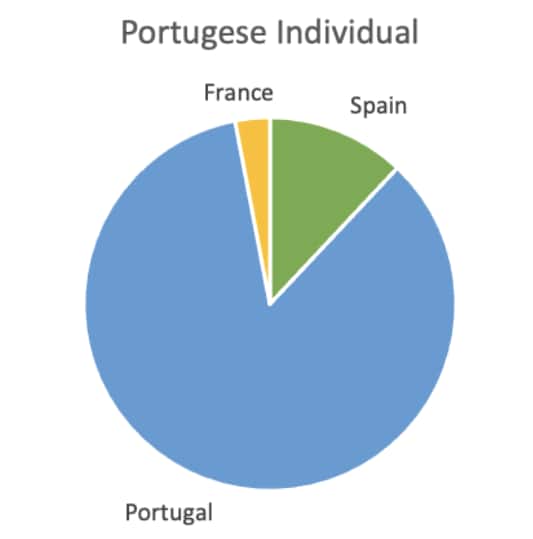
This is likely due to Spain and Portugal being close neighbors with centuries of trade and migration between them. This means that even if both your parents are from Portugal, you will likely not get 100% assignment to the Portugal region, but instead might get some assignment to Spain as well.
As we continue to improve our methods of analysis and increase the size of the reference panel we compare your DNA to, we should be able to provide more precise ethnicity estimates and better tell nearby regions apart. More sensitive tools may also mean we discover more instances of admixture between neighboring populations.
Ethnicity estimates include a predicted range
The percentage you get for a region in your ethnicity estimate is the most likely result we get after comparing your DNA to our reference panel. But it is not the only possible result. There are other percentages that are also likely. That’s why, in addition to your most likely result, we also provide a range of other possible percentages.
In this example, our results show that 7% of this person’s DNA looks most like DNA from people in Senegal. Additionally, we show that this estimate could range from 7% to 10%.
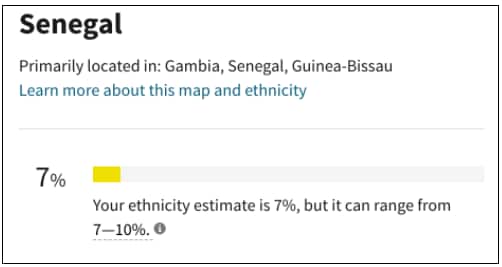
Essentially, 7% is our best estimate, but your actual percentage for an ethnicity region may be somewhat higher or lower than the most likely estimate. If you find that your estimated percentage for a region doesn’t match what you expect, remember that your actual percentage could fall somewhere in the range.
Importantly, the range of percentages can also include 0%. In these cases, even if you’re assigned a very small percentage to an ethnicity region, it’s possible you may not actually share any DNA with this region.
You can read more about how we determine the range of percentages.
There is some randomness in how DNA is inherited
A child inherits half of each parent’s DNA. Which DNA the child receives from each parent, however, is random. For example, if a parent is 50% European Jewish and 50% German, a child will not necessarily inherit equal amounts of European Jewish and German ethnicity from that parent. The child may inherit slightly more or slightly less of one or the other ethnicity.
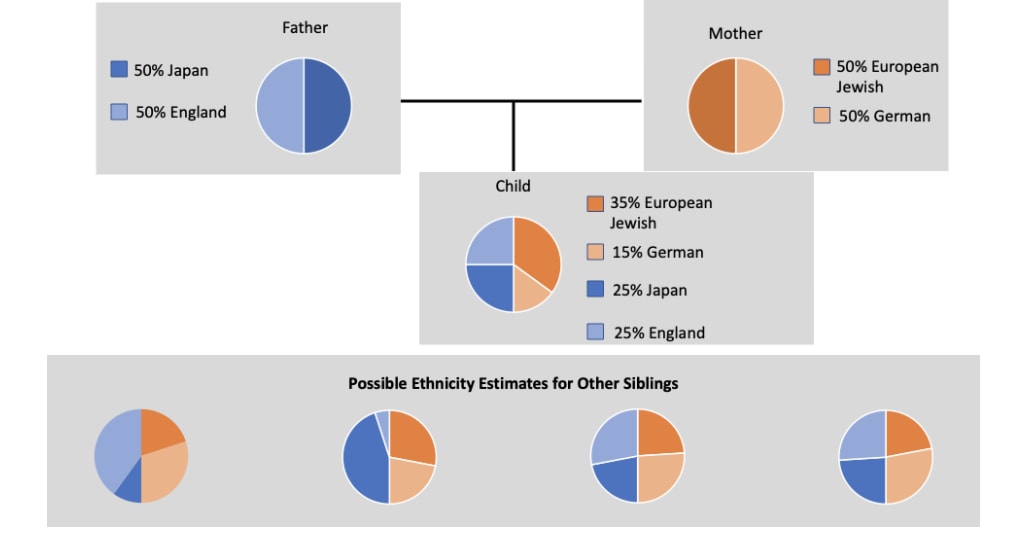
If you have siblings, you’ll all get a different mix of DNA from your parents (unless you’re an identical twin). So you might have a different ethnicity estimate than your siblings just because of the random way pieces of DNA are inherited.
You can read more about the random inheritance of DNA.
Here's another example. If you have a great-great-grandparent with Native American ancestry, you might expect to have 1/16th (about 6%) Indigenous Americas—North ancestry. However, the pieces of DNA that you inherited from this great-great-grandparent are random. When the DNA was passed from your great-great-grandparent to your great-grandparent to your grandparent to your parent and then to you, some pieces of DNA from this great-great-grandparent were not passed on.
Since you might not have much DNA from that great-great-grandparent, you might not show up as having any Native American genetic ethnicity.
This doesn’t prove that you don’t have any Native American ancestors or heritage. It just means that you didn’t inherit the genetic markers AncestryDNA uses to identify Native American ethnicity.
So keep in mind the random nature of DNA inheritance, especially if you don't have exactly the genetic ethnicities that you expected. If you’re interested in understanding more about how DNA is inherited, you can find out more here.
Ethnicity estimation is a complex problem
Another thing to keep in mind is that ethnicity estimation is a science that researchers around the world are continuing to develop. At AncestryDNA, we are on the cutting edge of this science, and we do our best to give you the best possible estimate. However, the fact is that ethnicity estimation is challenging (though we love that challenge).
Human history is complex, with lots of populations and ethnicities mixing together through centuries of migration, trade, marriage, and war. This makes assigning ONE ethnicity to each person nearly impossible. But it also means there is so much for you to discover by looking at your genetic ancestry.
You can be confident that we are giving you the best estimate possible given our current data and knowledge of human genetics. However, you can also be sure that we are working hard to continue to improve the precision of your ethnicity estimates as scientists unlock even more of the mysteries within the human genome.